

What AI Can (and Can't) Do for Your Code
A grounded take on AI in software development, and where you still matter most.
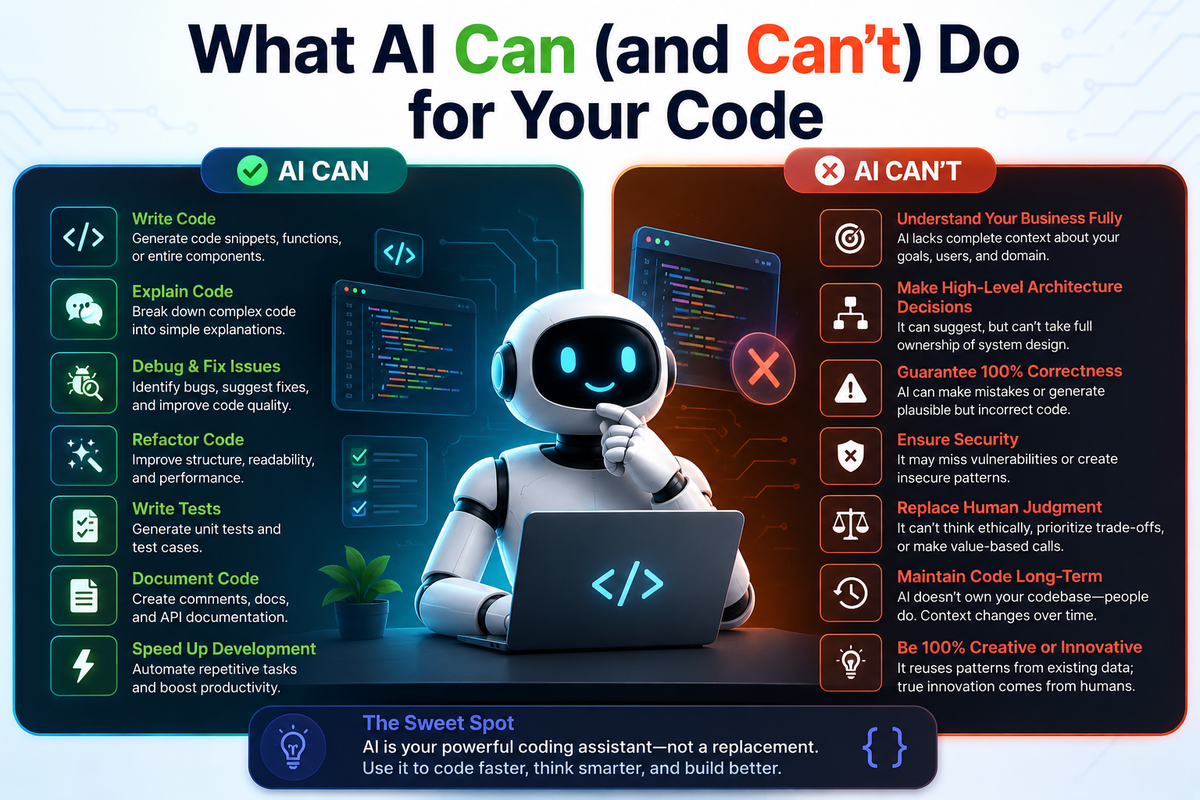
I want to talk about something that's been on my mind lately. Everywhere you look, someone is claiming AI will replace developers entirely. And honestly? I think that misses the point.
The truth is more interesting, and a lot more useful. AI is genuinely changing how we build software, but not in the "robots take over" way the headlines suggest. So let me share what I'm actually seeing, the good and the limits.
Quick take
- AI is brilliant at the repetitive, predictable parts of building software.
- It still struggles with the decisions that require real judgment and context.
- The teams winning right now pair AI's speed with human-guided structure.
What AI is genuinely great at today
Let's give credit where it's due. There's a whole category of work that used to eat up your week, and AI handles it beautifully now.
Think about boilerplate code, the same authentication flows, the same routing setup, the same project skeleton you've written a hundred times. AI can scaffold all of that in seconds. The same goes for repetitive CRUD operations, those endless create-read-update-delete screens that every data-driven app needs but nobody enjoys writing.
It's also surprisingly capable with schema design suggestions and data structure scaffolding. Point it at a problem, and it'll give you a reasonable starting shape for your database and models. That's real time back in your day, often the difference between a project that takes weeks and one that takes days.
This is the part I genuinely love. The grunt work that drained your energy? Much of it can be automated now, freeing you to focus on the work that actually moves the needle.
What AI can't replace (and probably won't anytime soon)
Here's where I want to be honest with you, because the hype tends to skip this part.
AI is fast, but it doesn't truly understand your business. System design decisions, how your pieces fit together, where to draw boundaries, what to optimize for, still demand human judgment. Two apps can solve the same problem in completely different ways, and knowing which approach fits your situation is something you bring to the table.
The same is true for business logic. The weird edge cases, the rules that only make sense because of how your industry works, the "we do it this way for a reason" knowledge. AI guesses at these. You actually know them.
And then there's the long game: maintainability and production-readiness. Anyone can prompt their way to something that runs on a demo. But will it hold up when you add roles, permissions, audit trails, and real users six months from now? That kind of durable architecture comes from intentional decisions, not lucky prompts. Prompt-only "vibe coding" feels magical right up until it becomes a tangle nobody wants to maintain.
The sweet spot: speed and structure
So where does that leave us? Honestly, in a pretty exciting place, if you stop treating it as either/or.
The best results come from combining AI's speed with a structured, human-guided workflow. That's exactly the thinking behind RadSystems. It's a database-first application builder, which means you start from your data and generate a complete, production-ready full-stack app, with clean code you actually own.
What I appreciate is how it blends both worlds:
- RadAssist brings AI assistance to schema and design decisions, so you move fast.
- Guided, wizard-driven workflows keep your architecture consistent instead of improvised.
- You get structured scaffolding, CRUD, authentication, and role-based access from day one.
- And you can generate across Laravel, Vue, ASP.NET Core, Node.js, and Python, then export and deploy anywhere. No lock-in.
It's AI doing the repetitive heavy lifting, with real structure underneath so your app stays maintainable as it grows.
The takeaway
AI isn't here to replace you. It's here to handle the parts of the job that never needed you in the first place—so you can spend your energy on the architecture, logic, and decisions that only a human can make well.
If you want to feel that balance for yourself, give it a try. Download the free 14-day trial no credit card needed—or schedule a quick demo, and I'll show you the workflow in action.
Comments ()