

The Limits of Vibe Coding: Why Structured, Deterministic Development Still Matters
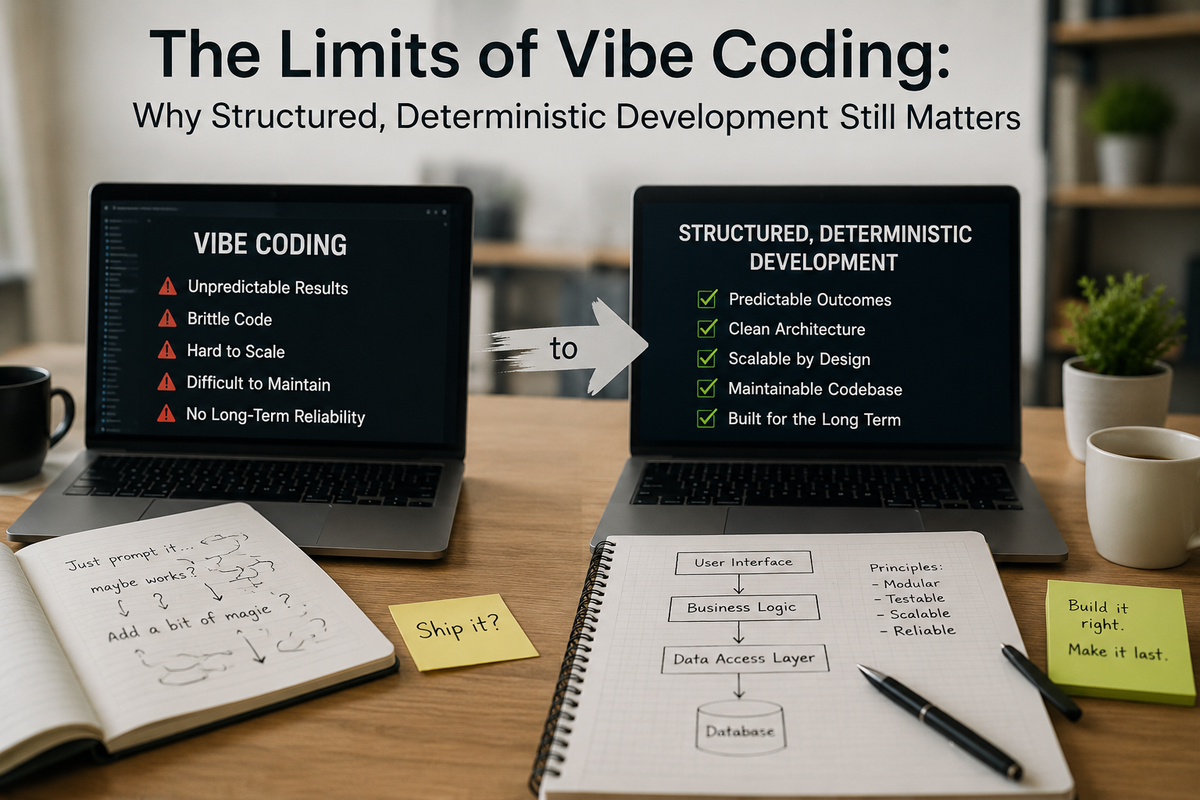
AI has changed how software gets built. A developer can now describe an idea in plain language, receive working code in seconds, and move from concept to prototype with remarkable speed. That shift has fueled the rise of vibe coding, a loose, prompt-driven way of building software by steering AI through natural language rather than following a clearly defined engineering process.
The appeal is obvious. Vibe coding feels fast, creative, and frictionless. It lowers the barrier to entry and makes software creation more accessible. Yet as teams move from experiments to production systems, its weaknesses become harder to ignore. Lack of structure and non-deterministic output can turn early momentum into long-term instability.
That is where the market is heading next. Teams do not just want speed. They want speed with control, automation with discipline, and AI assistance that fits into repeatable development workflows. This is the gap that creates demand for platforms like RadSystems X: tools that preserve the gains of AI-driven development while adding the structure, governance, and reliability serious application delivery requires.
What Vibe Coding Is, and Why It Caught On
Vibe coding is an informal approach to software creation where users rely heavily on conversational prompts to generate code, screens, features, or even entire applications. Instead of starting with architecture, specifications, and defined workflows, the process often begins with intent: “build me a dashboard,” “create a CRUD app,” or “add login and reports.”
In many cases, the AI does produce something useful. That is why vibe coding spread so quickly.
Why it feels powerful
Vibe coding solves a real problem: traditional development can be slow, expensive, and intimidating. AI removes much of the blank-page friction and gives users a rapid starting point.
Its strengths are clear:
- Fast prototyping
- Low barrier to entry
- Immediate feedback loops
- Useful for exploration and ideation
- Helpful for repetitive coding tasks
For founders, solo builders, and even experienced developers, this can feel like a breakthrough. You describe what you want, refine it in conversation, and watch the product take shape.
Where it works best
Vibe coding performs well in early-stage use cases such as:
- Mockups and proofs of concept
- Interface experiments
- Simple internal tools
- Learning and discovery
- Feature brainstorming
In these settings, speed matters more than precision. A rough result is often enough.
So what? Vibe coding is not the problem. The problem begins when teams try to use an inherently loose method to build systems that demand consistency, security, and long-term maintainability.
The Core Limitation: Vibe Coding Lacks Structure
Software development is not just about getting code to run. It is about creating systems that can be understood, tested, changed, secured, and scaled over time. That requires structure.
Vibe coding often skips that foundation.
Prompting is not architecture
A good prompt can produce a useful output. But prompts are not the same as:
- System design
- Naming conventions
- Shared component standards
- Data modeling discipline
- Security policies
- Deployment rules
- Versioned workflows
Without those elements, generated output becomes fragile. You may get a page, a feature, or a script that works in isolation, but not a system that holds together under real business demands.
A common misconception is that if AI can generate the code, the hard part is done. In practice, the hard part is often what comes next: making that code coherent across the whole application.
Unstructured inputs lead to uneven results
When different users prompt in different ways, the outputs differ in style, logic, organization, and quality. One team member may ask for a customer table. Another may ask for client records. A third may generate a similar module with a different naming pattern, validation flow, or access rule.
The result is familiar:
- Inconsistent code structure
- Duplicate logic
- Conflicting data models
- Weak documentation
- Difficult handoffs between team members
This is not a theoretical issue. It becomes visible the moment a project grows beyond a single prompt session.
Software teams need more than generated code
Production software depends on repeatability. Teams need to know:
- How modules are created
- How permissions are enforced
- How data flows between components
- How changes are reviewed
- How applications stay aligned as they evolve
Vibe coding often creates outputs without embedding those rules into the process itself.
So what? When structure is missing, speed becomes temporary. You move fast at the start, then slow down as inconsistency, rework, and maintenance costs pile up.
The Second Limitation: Vibe Coding Is Non-Deterministic
The second major issue is even more serious for production teams: non-deterministic output.
In simple terms, the same prompt does not always produce the same result. That may be acceptable in brainstorming. It is far less acceptable in application development.
Why non-determinism creates risk
In software projects, teams need outputs they can predict and reproduce. If a workflow generates different code, logic, or structure each time, it becomes harder to:
- Test reliably
- Debug efficiently
- Review changes
- Enforce standards
- Train teams
- Scale delivery across projects
This is where vibe coding starts to clash with professional development practices. Engineering teams are not only building features. They are managing risk.
Practical example: a simple CRUD module
Imagine a team wants to create a customer management module.
Using a vibe coding approach, one prompt session may generate:
- A customer table with basic fields
- Basic form validation
- Standard edit and delete actions
A second session, using a slightly different prompt, may generate:
- Different field names
- Different validation rules
- Different routing logic
- A new UI structure
- Different role handling
Now the team has two versions of the “same” business requirement. Both may function. Neither may align cleanly with the rest of the application.
That creates several problems:
- QA must test more variations
- Developers spend time reconciling differences
- Maintenance becomes harder
- Business rules drift over time
Non-determinism weakens trust
Once teams cannot predict output quality or structure, confidence drops. Developers start double-checking everything. Architects hesitate to approve AI-generated components. Managers stop seeing AI as a system of delivery and start seeing it as a source of drafts.
That shift matters. AI is most valuable when it becomes part of a trusted workflow, not just a clever assistant.
So what? Non-deterministic output may be tolerable for creative exploration, but enterprise software needs dependable patterns, not endless variation.
Why This Matters More as Projects Scale
A single developer can sometimes manage inconsistency through personal oversight. Teams cannot rely on that model for long.
As projects grow, three needs become unavoidable: governance, repeatability, and scalability.
Governance protects quality and security
Applications today must support auditability, permissions, compliance requirements, and secure data handling. These are not optional extras. They are part of the product.
Loose prompt-driven development often treats these concerns as follow-up tasks. Structured platforms embed them into the build process from the start.
Repeatability improves delivery speed
Most teams assume structure slows them down. In reality, the opposite is often true.
When workflows are standardized, teams can:
- Reuse proven patterns
- Reduce avoidable errors
- Onboard faster
- Ship updates with more confidence
- Maintain consistency across modules and projects
Repeatability is how fast teams stay fast.
Scalability requires discipline
An application may begin as a simple prototype, but business software rarely stays simple. New features arrive. Users increase. Data grows. Integrations multiply. Compliance demands expand.
A development approach that depends on loosely guided AI outputs can struggle under this pressure. What looked efficient in week one may become expensive by month six.
So what? Scaling software requires more than rapid creation. It requires a framework that keeps delivery aligned as complexity rises.
The Emerging Need: AI-Assisted Development With Structure
This is the next stage of the market. Teams are moving from asking, “Can AI generate this?” to asking, “Can AI help us build this reliably?”
That is an important shift.
The future does not belong to purely manual coding, nor to unrestricted prompt-based generation. It belongs to platforms that combine:
- AI acceleration
- Structured workflows
- Reusable patterns
- Consistent outputs
- Governance and control
In other words, the winning model is not chaos with speed. It is discipline with speed.
What teams now expect from modern development platforms
The demand is growing for solutions that can:
- Turn requirements into repeatable application components
- Standardize CRUD, forms, dashboards, and roles
- Support multiple deployment targets
- Integrate with databases and APIs consistently
- Preserve flexibility without sacrificing order
- Reduce manual coding without losing visibility or control
This is exactly why platforms in the low-code and AI-assisted development space are becoming more important. They address the real gap between prototype generation and production delivery.
How RadSystems X Addresses the Gaps Left by Vibe Coding
RadSystems X fits this need because it brings development structure to AI-era software delivery.
Rather than relying on open-ended prompting alone, it supports a more disciplined approach to application generation. That means teams can still move quickly, but within a framework designed for consistency and maintainability.
1. It adds structure to fast development
Vibe coding often begins with a blank prompt. RadSystems X begins with a development model.
That distinction matters.
A structured platform helps teams define and generate applications using standardized patterns for:
- Data handling
- CRUD operations
- Forms and workflows
- Authentication and access rules
- UI components
- Application logic
This reduces the randomness that often appears in prompt-only workflows.
2. It improves consistency across outputs
When teams use a governed platform, they are not reinventing patterns every time they build a module. The output becomes more predictable.
That creates major benefits:
- Easier code review
- Simpler maintenance
- Better team collaboration
- More reliable testing
- Lower rework costs
Consistency is not a constraint. It is a force multiplier.
3. It supports maintainable, scalable applications
Generated output has value only if it can be extended and supported over time. RadSystems X is well positioned here because it serves not just as a generation engine, but as a repeatable application development environment.
This helps teams move beyond “it works for now” toward “it will keep working as we grow.”
4. It preserves speed without sacrificing discipline
This is the strongest argument in its favor. Teams do not want to go backward to slower, more manual processes. They want a better version of accelerated development.
RadSystems X offers that middle ground:
- Rapid generation
- Lower coding overhead
- Clearer structure
- Better control
- More dependable outcomes
That combination is powerful because it reflects how real teams build: fast when possible, careful where necessary.
So what? RadSystems X does not reject AI-driven development. It makes it practical for teams that need speed and stability at the same time.
A Practical Scenario: From Prompt Chaos to Repeatable Delivery
Consider a small product team building an internal operations app. They need user roles, approval workflows, reporting dashboards, and database integration. With vibe coding alone, they may generate screens quickly, but soon face familiar issues:
- Access rules are inconsistent
- Field validation differs between modules
- Naming patterns drift
- UI behavior changes from page to page
- Updates require manual cleanup
At first, these look like minor issues. Then the app grows. More users come in. Management wants changes. Security questions arise. The prototype now needs production discipline.
A platform like RadSystems X changes that path.
Instead of generating each part as an isolated response, the team builds from repeatable patterns. CRUD modules follow consistent logic. Roles and permissions are applied systematically. Database connections are managed within a more controlled structure. The output is faster to understand, easier to update, and safer to deploy.
That is the difference between AI as improvisation and AI as a delivery system.
Common Mistakes Teams Make With Vibe Coding
The excitement around AI-generated software can lead teams into avoidable traps. Here are some of the most common ones.
Mistake 1: Confusing a prototype with a production-ready app
A generated result that looks complete is not always engineered for scale, maintenance, or security.
Better approach: Treat early AI output as a draft unless it is produced within a structured development framework.
Mistake 2: Assuming prompt quality can replace the process
Better prompts help, but they do not replace architecture, standards, and governance.
Better approach: Use prompts to accelerate work inside a repeatable system, not as a substitute for one.
Mistake 3: Ignoring maintainability
Teams often focus on how quickly a feature appears, not how easily it can be updated six months later.
Better approach: Prioritize consistency, naming standards, and reusable patterns from the start.
Mistake 4: Overlooking team collaboration
Prompt-driven work can become personal and opaque. One person knows how something was generated, while others inherit the output without context.
Better approach: Build with tools and workflows that make logic visible, standardized, and transferable.
So what? The biggest risk with vibe coding is not that it fails immediately. It is that it succeeds just enough to hide deeper structural weaknesses.
By: Humphrey Okeke
Comments ()