

The Future of Rapid Application Development in 2026
Discover how Rapid Application Development in 2026 leverages low-code and AI to help businesses build faster and scale smarter.
A New Era of Speed and Innovation
Software development is no longer measured in months, it is measured in weeks, sometimes even days. As we move through 2026, Rapid Application Development (RAD) is evolving from a niche methodology into a mainstream strategy for businesses that want to compete in fast-moving markets.
Organizations can no longer afford long development cycles, bloated teams, and delayed product launches. Customers expect continuous updates, seamless digital experiences, and solutions that adapt quickly to their needs. In this environment, speed is not just an advantage, it is a requirement.
Rapid Application Development is becoming the framework that enables this new pace of innovation.
Traditionally, RAD focused on quick prototyping and iterative feedback. While those principles remain relevant, the approach has matured significantly in 2026. Modern RAD is powered by automation, API-first architectures, and low-code environments that accelerate not just prototyping, but full production deployment.
Today’s development teams use automated scaffolding, reusable components, and centralized backend systems to reduce repetitive coding. This allows them to spend less time building infrastructure and more time refining user experience, performance, and strategic features.
The result is continuous delivery, not just rapid prototyping.
The Rise of Low-Code and Hybrid Development
One of the most significant drivers of RAD’s evolution is the growth of low-code development platforms. These tools automate backend generation, authentication systems, database relationships, and administrative interfaces, dramatically reducing setup time.
However, the future of RAD is not purely “low-code.” It is hybrid.
Developers increasingly combine visual development tools with full-code customization. This balance ensures speed without sacrificing flexibility. Platforms like RadSystems Studio reflect this shift by generating structured, production-ready applications while still allowing developers to extend and customize the underlying code.
In 2026, the winning approach is not replacing developers, it is amplifying them.
AI-Enhanced Development Workflows
Artificial intelligence is also reshaping Rapid Application Development. AI-assisted code suggestions, automated testing tools, and intelligent debugging systems are shortening development cycles even further.
Instead of manually writing every line of code, developers now focus on architectural decisions and problem-solving while AI handles repetitive or pattern-based tasks. This collaboration between human expertise and intelligent automation is pushing RAD to new levels of efficiency.
The outcome is faster iteration, fewer errors, and improved software quality.
Multi-Platform Expectations as the Standard
In 2026, building for a single platform is rarely sufficient. Users expect web apps, mobile apps, and even desktop solutions to work seamlessly together. Rapid Application Development now prioritizes unified codebases and API-driven systems that support deployment across multiple environments.
This multi-platform focus ensures that businesses can launch quickly while maintaining consistency and scalability. It also reduces long-term maintenance complexity, a critical factor for sustainable growth.
Why Businesses Are Embracing RAD More Than Ever
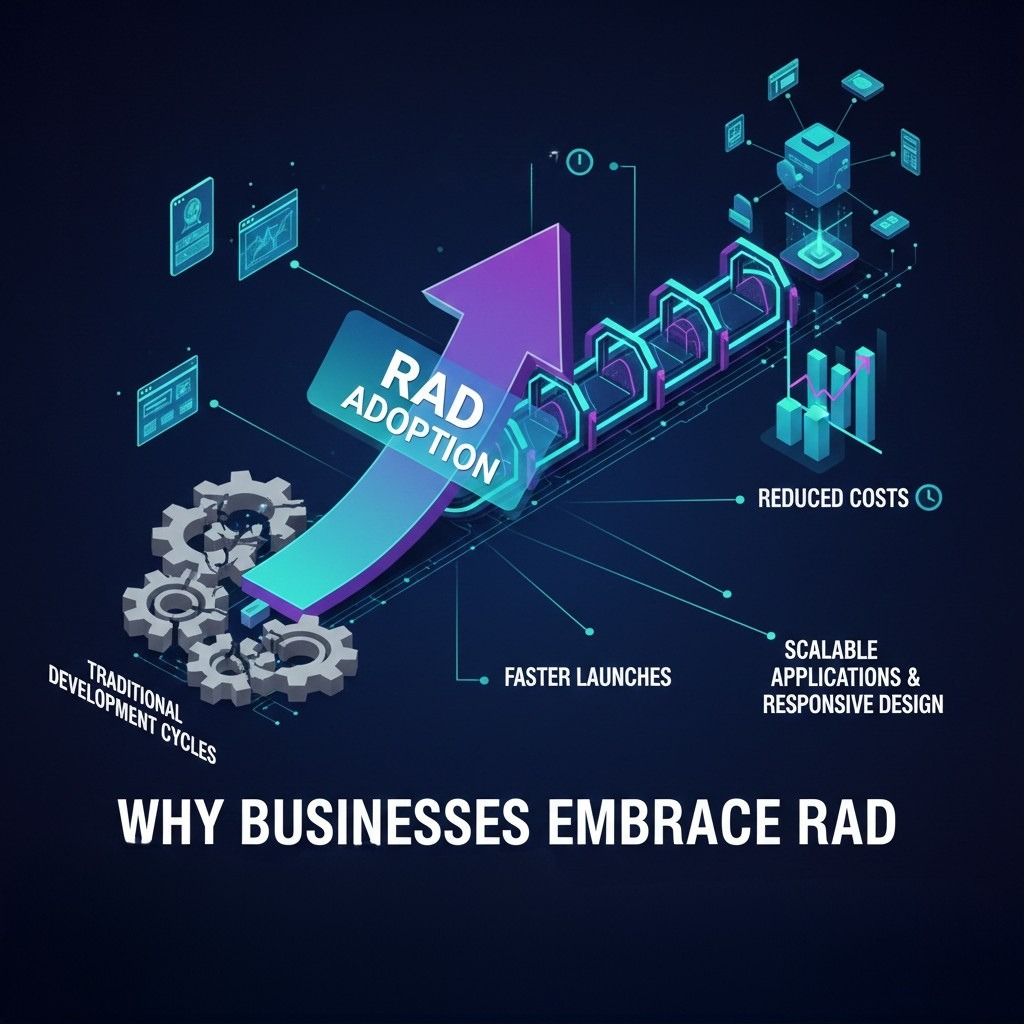
The appeal of Rapid Application Development is simple: it aligns technology with business speed.
Companies are embracing RAD because it allows them to:
- Launch products faster
- Respond quickly to market feedback
- Reduce development costs
- Scale applications efficiently
- Minimize technical debt
In competitive industries, the ability to adapt quickly often determines survival. RAD provides the operational agility that modern organizations need.
The Competitive Advantage in 2026
The future of Rapid Application Development is not just about building faster, it is about building smarter. Automation, low-code tools, AI integration, and scalable architectures are redefining how applications are created and maintained.
Businesses that adopt modern RAD strategies will innovate more quickly, deliver better user experiences, and outpace competitors still relying on traditional, linear development cycles.
Speed alone is no longer enough. Structured speed is the real advantage.
Ready to Accelerate Your Development Process?
The future of Rapid Application Development is here and the teams that embrace it will lead their industries.
If you’re ready to shorten development cycles, reduce costs, and deliver scalable applications faster, explore how modern low-code and hybrid development tools can transform your workflow.
Start building smarter, faster, and more efficiently today. The next breakthrough product doesn’t have to take months — it can start now.