

Progressive Web Apps (PWA): The Evolution of Web Apps and a Smarter Way to Build Them
Progressive Web Apps are redefining how modern web applications are built and delivered. This article explores their architecture, challenges, and how RadSystems Studio provides a smarter way to build production-ready PWAs.

Progressive Web Apps (PWAs) have moved far beyond buzzword status. In a landscape where users expect instant, seamless, and reliable digital experiences regardless of device or connection quality, PWAs have emerged as a transformative approach to building web applications. Once seen as a fringe alternative to native mobile apps, PWAs are now driving real business impact across industries — from e-commerce and media to travel, retail, and enterprise tools.
In 2024, the global PWA market was valued at over USD 2 billion and is forecasted to grow at nearly 30% compound annual growth rate (CAGR) through this decade, fueled by rising internet and smartphone adoption, cross-platform ease, and growing demand for performant digital experiences.
This growth isn’t just financial — it’s practical. Brands that have adopted PWAs often see meaningful improvements in engagement, conversions, and retention. For example, PWA implementations have been associated with conversion uplifts of 36% or more, and user engagement increases ranging up to 180% compared to traditional apps or sites. Clearly, PWAs represent more than a trend — they’re a strategic choice for delivering modern digital experiences.
What Makes a Web App “Progressive”?
At its heart, a Progressive Web App is a web application that behaves more like a native mobile app without the friction of installation from an app store. Users access PWAs through a web browser, but thanks to modern APIs and architectural patterns, they behave in ways previously only possible with native code.
These capabilities enabled by browser features turn ordinary web technology into experiences that feel reliably “app-like.”
Importantly, PWAs are built on standards. They rely on familiar front-end technologies like HTML, CSS, and JavaScript, and they can be delivered over HTTPS, which is a baseline requirement for key features like service workers.
The Architecture Behind PWAs
To understand PWAs beyond marketing language, it helps to consider their core architectural components and how they work together to deliver that superior experience.
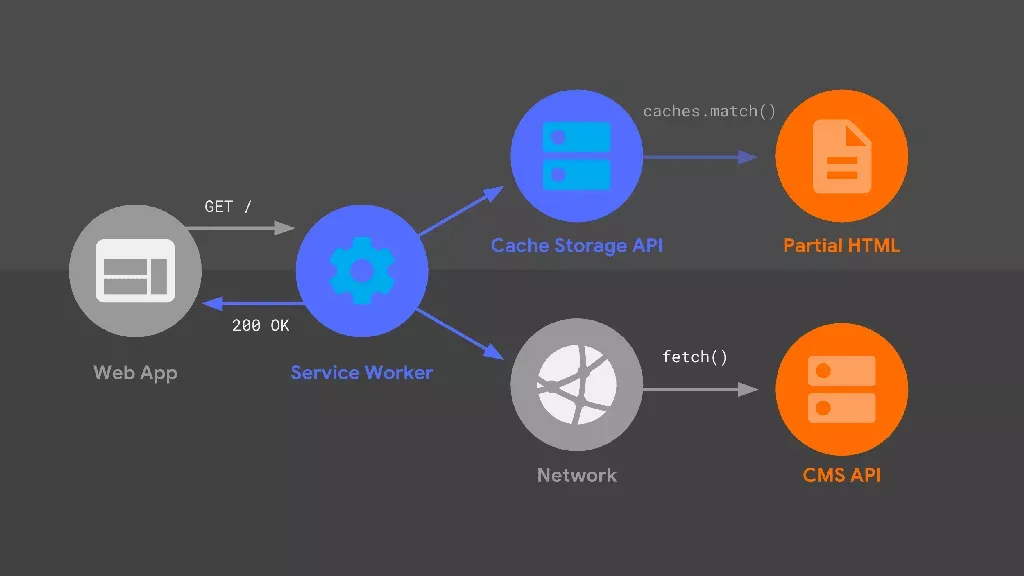
Service Workers: The Heartbeat of Progressive Behavior
At the center of most PWAs is the service worker, a specialized JavaScript script that runs in the background of the browser. Unlike typical scripts tied to page lifecycle, a service worker can intercept network requests, manage intelligent caching strategies, and even respond to network requests when offline.
Service workers unlock many of the capabilities that distinguish PWAs:
- Caching assets and API responses so parts of the app work offline.
- Responding instantly to navigations after the first load.
- Managing background sync to keep local and remote data in sync.
- Enabling push notifications for re-engagement.
Because service workers operate independently from user-triggered page scripts, they introduce a new architectural layer that must be designed thoughtfully to prevent stale data, inconsistencies, or unintended behaviors.
Web App Manifest: Making It Installable
Alongside service workers, PWAs include a Web App Manifest, a JSON file that describes how the app should appear when installed. This manifest defines icons, app name, start URL, display modes (e.g., fullscreen or minimal UI), and other metadata that help browsers treat the PWA like a first-class application.
Manifest files bridge the web and native experience, allowing users to “install” a web app to their home screen or desktop without going through an app store. This increases discoverability and puts the app a tap away — without the typical costs and barriers associated with native app distribution.
HTTPS and Security

Security is not optional in PWAs. Browsers enforce HTTPS for service worker functionality, ensuring that all exchanges between application and user are encrypted and tamper-proof. This upfront requirement means modern PWAs inherently respect security best practices — which is increasingly important in today’s threat landscape.
Common Challenges in PWA Development
Despite their advantages, PWAs introduce architectural complexity that can be challenging for developers.
Offline data handling, for example, demands careful decisions about what to cache and when to refresh it. Without a thoughtful strategy, users may see stale content or encounter confusing behavior when reconnecting after offline use.
Service worker code itself must be robust and maintainable; debugging service workers is often less straightforward than debugging ordinary front-end code. Features also vary between browsers, so developers must include graceful fallbacks and feature detection to ensure consistent user experiences.
Performance expectations are high for PWAs, users expect instantaneous responses, smooth transitions, and minimal resource usage. Achieving this across devices (especially older phones or low-end hardware) requires intentional optimization at every layer.
Finally, maintaining evolving service worker logic and cache versioning can be a source of long-term technical debt if not managed properly.
Why Developers and Teams Are Choosing PWAs
Despite the challenges, the benefits of PWAs are clear. They deliver:
- Consistent performance even under poor network conditions.
- Reduced development overhead by sharing a single codebase across platforms.
- App-like installability without app store restrictions.
- Improved user engagement and retention metrics.
In sectors like e-commerce, travel, and media, traffic from PWA-enabled sites now accounts for a significant proportion of overall user sessions, highlighting how broadly the technology is being relied upon to deliver compelling experiences.(Source: Perma Technologies)
RadSystems Studio: Simplifying PWA Development Without Sacrificing Power
Given the architectural demands of quality PWAs, many teams are exploring tools that help streamline development while preserving flexibility.
Rather than forcing developers to manually set up service workers, manage manifest files, and configure caching strategies from scratch, RadSystems Studio encapsulates these concerns into its application design workflow. Developers can focus on user experience and business logic while RadSystems generates the necessary code for PWA behind the scenes.
For teams that value rapid iteration and easier maintenance without sacrificing control, this approach provides a compelling middle ground between manual code and fully abstracted platforms. Advanced users can still define application logic, API interactions, and dynamic behaviors with precision, while less code-centric stakeholders can participate in the build process.
With RadSystems Studio handling boilerplate PWA infrastructure such as offline-first asset caching, installability configuration, and secure build outputs, teams spend less time wrestling with platform intricacies and more time building meaningful product features.
The Path Forward
Progressive Web Apps represent an important convergence of web technology and user expectations. They’re fast, resilient, and increasingly powerful — and the market’s projected growth reflects that more organizations see PWAs as a strategic investment, not a novelty. Whether you’re building a consumer brand experience, internal business tool, or cross-platform service, PWAs offer a way to deliver consistent, high-quality digital experiences without the traditional costs and fragmentation of native development.
Tools like RadSystems Studio demonstrate how modern development platforms can lower the barrier to entry, enabling teams to adopt PWA technology more confidently and efficiently.
For developers and tech enthusiasts alike, PWAs are not just another trend; they’re a practical, high-value approach to the next generation of web experiences.
Get your copy of RadSystems Studio today and start developing your PWA projects faster than ever before!