

Node.js vs. Laravel: Choosing the Right API Engine for Your RadSystems Project
I remember sitting in a glass-walled conference room a few years ago, staring at a client who was describing what sounded like the "Delivery tracking niche logistics." He wanted real-time driver tracking, instant push notifications, and a complex inventory system that could handle thousands of SKUs. My first instinct, fueled by the latest tech trends, was to shout, "We’ll build it in Node.js! It’s fast, it’s modern, it’s the future!"
But then, he dropped the bombshell. "Oh, by the way," he said, "our internal IT policy requires this to run on our existing Windows Server 2016 box in the basement. On top of that, our in-house talent is only well-versed in PHP. We simply can't afford to hire new staff right now, and we don't have the luxury of time to upskill our current team to get a good grasp of a completely new technology like Node.js."
He must have sensed my thoughts because just as I was about to suggest a support and maintenance contract, he leaned in with a knowing smile, making it even clearer. "We can’t outsource the maintenance for obvious privacy and security reasons, either. It has to stay in-house. So, whatever you build, it has to be within the confines of anything based on PHP and HTML."
I felt that familiar sink in my stomach. The "perfect" tech stack I had in mind just collided head-on with the messy reality of the client's infrastructure.
Does this situation sound familiar to you? Have you ever sat down with RadSystems Studio, ready to hit the "Generate" button, only to freeze when you see that dropdown menu asking you to choose between Node.js and PHP Laravel?
It’s a moment of paralysis that every developer has faced, especially those of us using low-code tools to move fast. We want the performance of the "new thing," but we need the reliability of the "old faithful."
It’s the one that won’t get you a frantic phone call at 2:00 AM because the server environment couldn't handle the runtime.
Let me share how I’ve learned to navigate this choice, not by looking at documentation, but by looking at the person sitting across the table from me.
When "Boring" is Actually Better: My Laravel Story
A while back, I took on a project for a local manufacturing firm. They needed a massive internal ERP to track everything from raw materials to employee shifts. This wasn't a public-facing app. It was a "deep" application with over 40 database tables all talking to each other.
When I looked at their setup, they had a traditional office network. No cloud, no Docker, just a standard server. In this world, Laravel is king.
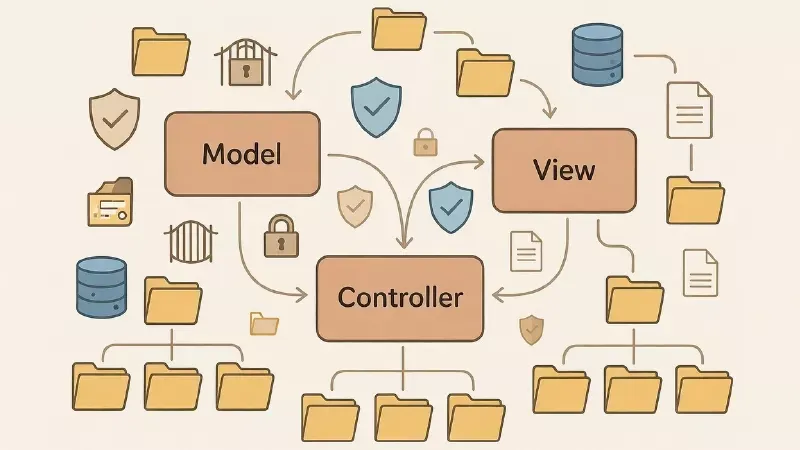
I chose Laravel for them because of its "opinionated" nature. In RadSystems, when you generate a Laravel API, it follows a very strict MVC (Model-View-Controller) structure.
Laravel in RadSystems Studio also comes with "batteries included." Things like complex user permissions, encrypted data handling, and generating PDF reports are baked into the RadSystem's DNA. For this manufacturer, security was a massive concern. They didn't want to hear about "custom middleware" for security. They wanted to know the gate was locked. Laravel’s built-in protection offered by RadSystems Studio against common web attacks meant I didn't have to reinvent the wheel.
The app wasn't expected to be "blazing fast" in the way a chat app is, but it was incredibly stable. For a business that just needs to process 100 invoices a day without a glitch, the structure of Laravel provides a peace of mind that raw speed can't replace.
The Need for Speed: When Node.js is the Only Answer
Now, let's look at the flip side. I had another client, a startup in the delivery space. Their requirements were the polar opposite. They didn't have 60 tables of data, but they did have 500 delivery riders who all needed to send their GPS coordinates to the server every 10 seconds.

If I had used Laravel for this, the server would have struggled under the weight of opening and closing thousands of synchronous connections every minute.
For this project, I went with Node.js.
Node.js is built for high-concurrency. It’s like a high-speed short-order cook who never stops moving. It handles thousands of "tiny" requests simultaneously without breaking a sweat.
However, I only made this choice because the client was ready for a modern infrastructure. They were using a VPS (Virtual Private Server) where I could easily install the Node runtime and manage the process. If your client is on a $5 shared hosting plan meant for WordPress, please, do yourself a favor and stay away from Node.js. It needs room to breathe and a server that lets it run its own process.
The Reality of Maintenance (The "Day After" Problem)
We often forget that building the app is only 20% of the journey. The other 80% is maintaining it.
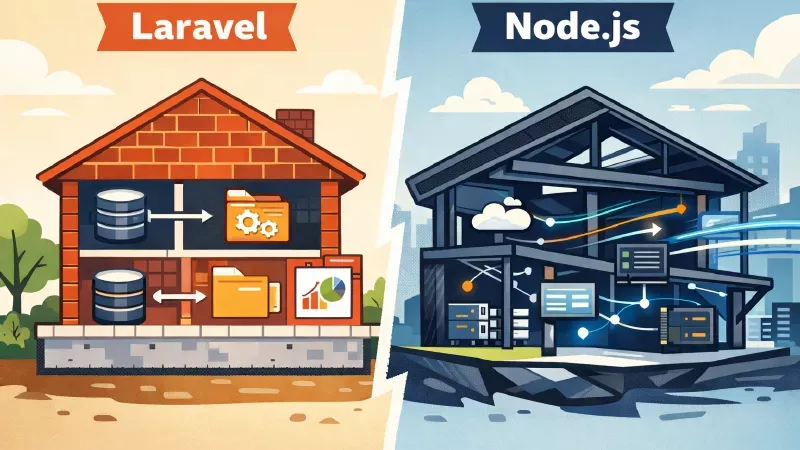
When I build with Laravel, I feel like I’m building a brick house. It’s solid. It’s hard to move the walls later, but you know exactly where the foundation is. If a client wants to add a complex reporting module a year later, Laravel’s Eloquent ORM makes those database queries a breeze to write and maintain. RadSystems Studio offers an easy database sync in just one button click, and I'm all set again to incorporate new features and changes requiested.
When I build with Node.js, I feel like I’m building with high-tech carbon fiber. It’s light and incredibly fast, but it requires more discipline. Because Node.js is "unopinionated" (it doesn't force you to follow a specific style), it’s easy for a project to become messy if you aren't careful. If you’re a solo developer who likes total control over every line of code, you’ll love the flexibility of the Node.js output in RadSystems. But if you’re handing the project off to a junior team, the "rules" of Laravel might save their lives (and yours).
So, How Do You Choose?
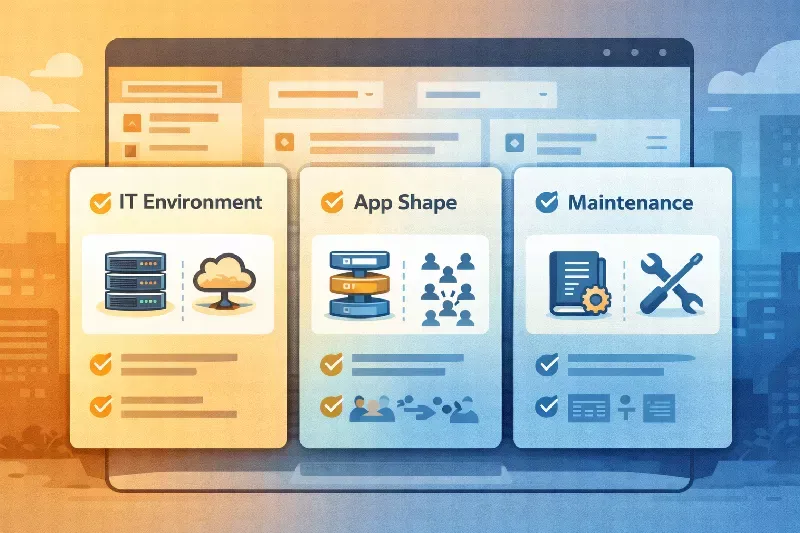
Next time you’re staring at that RadSystems project setup screen, try asking yourself these three questions instead of looking at tech specs:
- What is the "vibe" of the client's IT? If they have an old-school IT department or basic hosting, go with Laravel. It’s compatible with almost everything. If they are tech-forward and using the cloud, Node.js is a great candidate.
- Is the app "Deep" or "Wide"? If it has a hundred different pages and complex business rules, Laravel’s structure will keep you sane. If it has a few pages but needs to support thousands of people clicking buttons at the same time, Node.js is your best friend.
- Who is maintaining this? If you need a "standard" project that any developer can understand in ten minutes, Laravel wins. If you want a cutting-edge, high-performance API and you have the skills to manage a more flexible environment, go Node.js.
At the end of the day, RadSystems Studio is a powerful tool because it gives us the freedom to make these choices without getting bogged down in the syntax. The no-code capabilities allow us to quickly scaffold an entire application and build a fully functional prototype in hours, not weeks.
There is no guesswork involved and certainly no struggling with expert AI prompt writing just to get a working route. It’s just pure, functional code that I can deploy immediately into the client’s actual environment.
This lets me benchmark the performance on their real servers before we commit to the final build, ensuring the "pro" move we make is based on reality rather than a hunch.
What makes it even better is that RadSystems offers the same interface for all frameworks, which really flattens the learning curve. Once the benchmarking is done and the framework is settled, I don’t have to start over. I use the very same project to extend the functionality using its low-code capabilities, implementing complex business logic to build a pro-grade final application.
What about you? Have you ever regretted a backend choice because the server environment wasn't what you expected? I’d love to hear your stories of nightmeres or successes in the comments.