

How AI Is Transforming Software Development (And What It Can't Replace)
AI is changing how we write code. But writing code is only one part of building software.
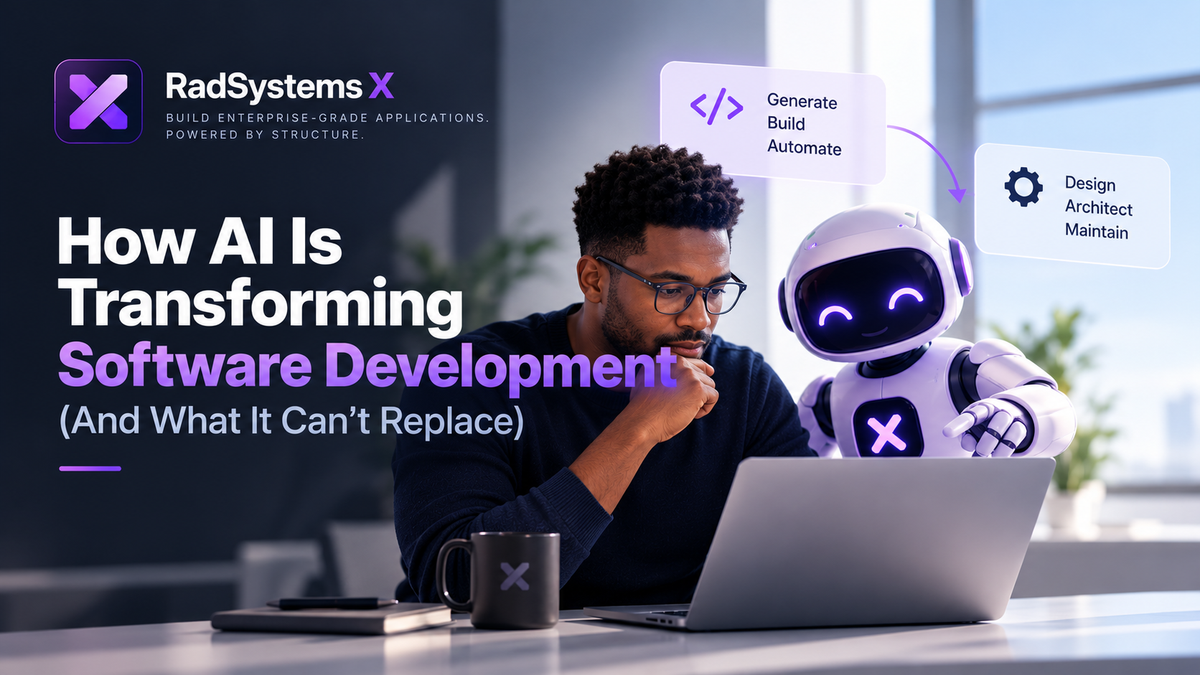
A few years ago, building an application meant manually writing almost everything, from database queries and APIs to authentication and user interfaces.
Today, AI can generate much of that in seconds.
It can help developers write functions, debug errors, generate tests, design interfaces, and even create working applications from natural-language prompts.
That's a remarkable shift.
But here's the question we should be asking:
If AI can generate software faster than ever, why do we still need software engineers?
The answer is simple: Generating code and engineering a reliable system are two different things.
What AI Is Already Changing
AI is becoming a powerful development partner, especially in four areas:
1. Code Generation
Developers can describe functionality in plain English and receive working code in seconds. This reduces repetitive coding and accelerates prototyping.
2. Debugging and Testing
AI can identify potential bugs, explain errors, suggest fixes, and generate test cases. It helps developers troubleshoot faster, although its suggestions still require validation.
3. Database and API Development
AI can generate database schemas, SQL queries, API endpoints, and integration code, significantly reducing initial development effort.
4. Documentation and Refactoring
AI can explain unfamiliar code, generate technical documentation, and suggest improvements to existing implementations.
These capabilities are transforming developer productivity.
But automation has limits.
What AI Can't Reliably Replace
1. Architectural Decision-Making
Should an application use a modular monolith or microservices? How should data flow between services? Which components need to be independently scalable?
AI can recommend approaches, but those decisions depend on business requirements, infrastructure, budgets, and long-term objectives.
2. Business Logic and Domain Understanding
AI can implement instructions. But understanding why a business operates a certain way, identifying exceptions, and translating complex requirements into reliable workflows still require human judgment.
3. Security and Governance
Generating a login page is easy.
Designing a secure authentication system with appropriate permissions, audit trails, data protection, and regulatory considerations is much more complex.
4. Long-Term Maintainability
An application might work perfectly today but become difficult to modify six months later.
Consistent architecture, reusable components, documentation, and clear development standards determine how easily software evolves.
5. Accountability
When an AI-generated system fails, an organization still needs people who understand its design, can investigate the failure, and take responsibility for fixing it.
AI assists engineering. It doesn't eliminate engineering accountability.
The Real Opportunity: AI + Structured Development
At RadSystems, we believe the biggest opportunity isn't simply generating more code with AI.
It's generating better software through AI-powered, structured development.
Imagine combining:
- AI-assisted database design with defined data relationships.
- Rapid application generation with consistent architectural patterns.
- Automated workflows with built-in authentication and role-based access control.
- Multi-framework development with full source-code ownership.
- AI-assisted coding with the flexibility to customize and maintain applications independently.
That's the direction we're taking with RadSystems X.
Our vision is to make enterprise-grade application development accessible to more people without compromising the engineering foundations that make software reliable.
The Future Developer Won't Just Write Code
The role of developers is evolving.
As AI handles more repetitive implementation work, developers can spend more time understanding business problems, designing systems, validating solutions, and making architectural decisions.
The most valuable skill may no longer be how quickly you can write code.
It may be how effectively you can design, guide, and maintain the systems that AI helps you build.
AI is making software development faster and more accessible.
But speed without structure can create complexity just as quickly.
The future of software development isn't AI replacing engineers. It's AI empowering more people to build well-engineered systems.
That's the future we're building toward at RadSystems.
What's one software engineering responsibility you believe AI will never fully replace?
Share your thoughts in the comments.
RadSystems X
Build Enterprise-Grade Applications. Powered by Structure.
Learn more: https://radsystems.io/
#ArtificialIntelligence #SoftwareDevelopment #RadSystems #RadSystemsX #SoftwareArchitecture #LowCode #AIEngineering #FutureOfSoftware
Comments ()