

How Agencies Can Scale Faster with Low-Code IDEs
Discover how agencies can accelerate delivery, reduce costs, and scale efficiently using Low-Code IDEs without sacrificing code quality.
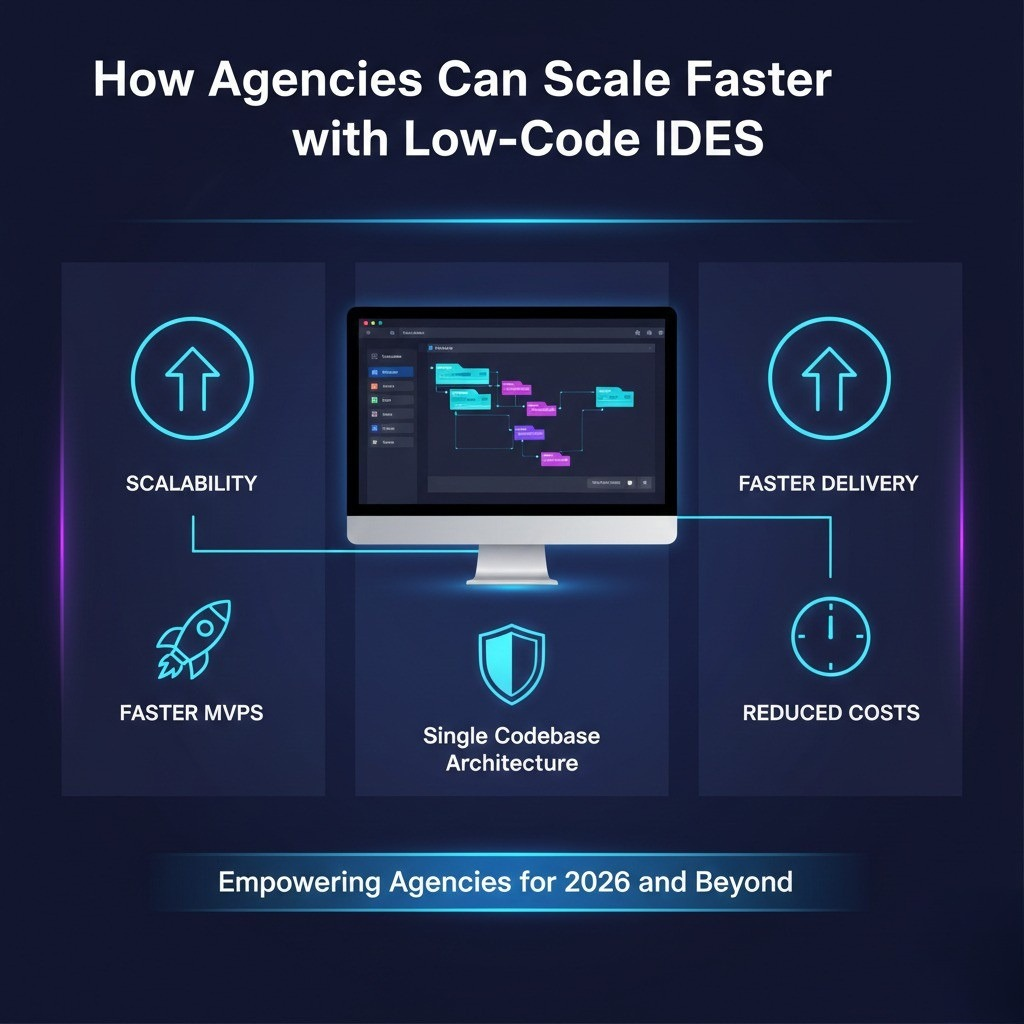
Every growing agency dreams of taking on more clients, securing larger contracts, and delivering projects faster. But scaling an agency is not just about winning new business; it’s about execution. As client demand increases, so do deadlines, revisions, integrations, and platform expectations. Developers get stretched thin, projects overlap, quality starts slipping, and margins shrink. The bottleneck is rarely creativity, it is development capacity.
Traditional development models simply don’t scale linearly. Each new client often requires rebuilding the same back-end logic, creating forms, configuring databases, and setting up authentication systems from scratch. This repetitive work consumes time and resources, slowing growth and increasing costs. Hiring senior engineers can help, but it is expensive, and larger teams require more coordination. To scale efficiently, agencies need repeatable architecture, reduced boilerplate coding, multi-platform flexibility, faster MVP delivery, and maintainable code. Modern Low-Code Integrated Development Environments (IDEs) are designed to address all of these challenges, enabling agencies to grow without multiplying their development team proportionally.
Speed Without Sacrificing Quality
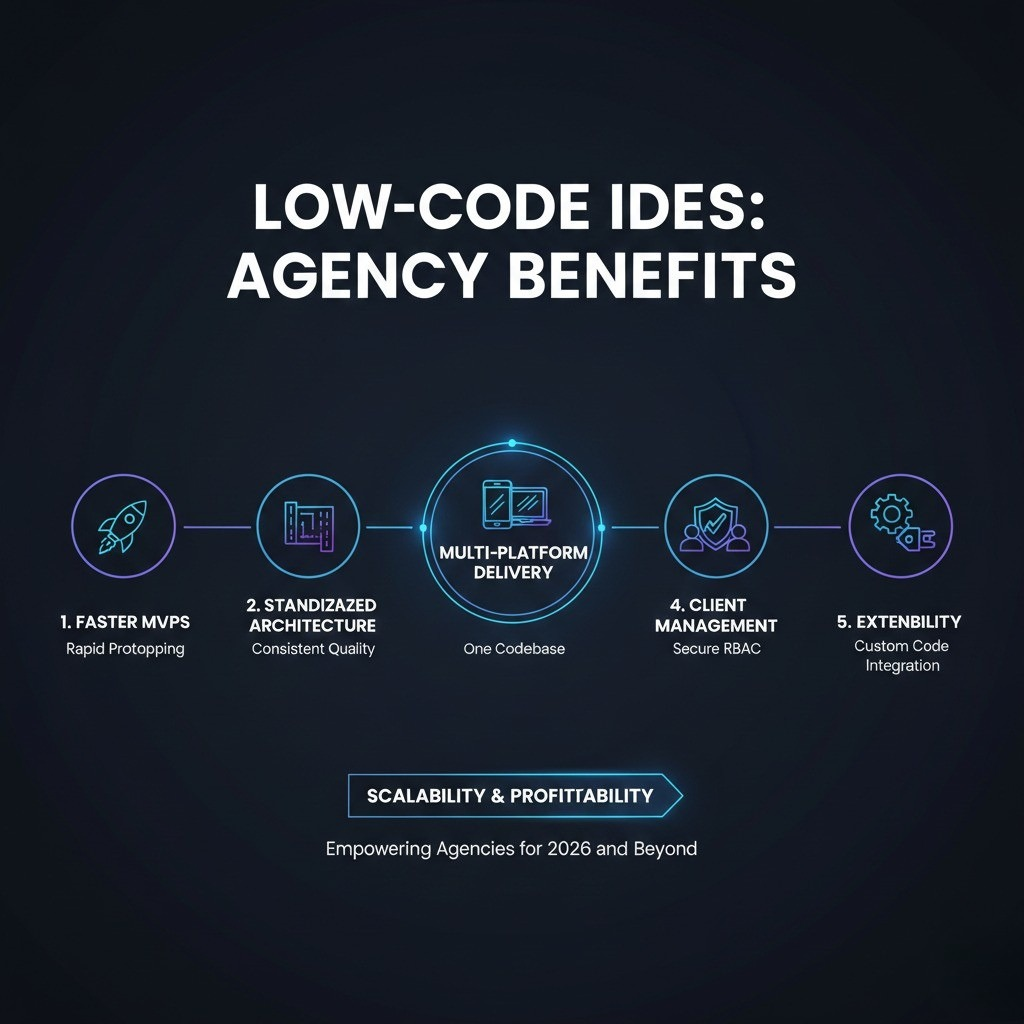
One of the most significant advantages of Low-Code IDEs is the ability to accelerate development without sacrificing quality. Many agencies hesitate to adopt low-code tools because they fear losing control over their applications. The reality is that modern platforms generate clean, production-ready code using well-established frameworks like Laravel, ASP.NET Core, Node.js, and Python Flask. This allows agencies to auto-generate backend logic, scaffold CRUD operations, build authentication systems, and configure role-based access, all while maintaining full access to the source code. In practice, developers can complete 70–80% of an application visually and focus their time on the client-specific customizations that add real value. The result is a dramatic reduction in development time without locking the agency into a rigid or proprietary system.
Standardized Architecture Across Projects
Consistency in architecture across projects is another major factor for scalable agencies. Different developers structuring applications differently can create maintenance headaches and technical debt. Low-Code IDEs promote architectural standardization, ensuring every application follows organized patterns, clean database relationships, and consistent authentication flows. This reduces onboarding time for new developers, makes bugs easier to identify, and simplifies long-term maintenance. By standardizing project structure, agencies can maintain high-quality output even as the number of concurrent projects grows.
Delivering Multi-Platform Solutions from One Codebase
Clients today also expect more than simple web applications. They want multi-platform solutions, including mobile apps, desktop software, and Progressive Web Apps (PWAs). Developing each platform independently multiplies effort and cost. Low-Code IDEs enable agencies to generate web apps, SPAs, mobile applications via Quasar + Vue, and Electron-based desktop apps from a single codebase. This multi-platform flexibility allows agencies to offer higher-value solutions without multiplying development time, increasing both client satisfaction and agency revenue potential.
Handling Multiple Clients with Structured Permissions
As agencies scale, managing multiple clients also becomes increasingly complex. Client portals, multi-tenant dashboards, and SaaS platforms require structured permissions to ensure security and operational efficiency. Low-Code IDEs include dynamic Role-Based Access Control (RBAC), allowing agencies to define granular permissions, create hierarchical roles, modify access without code changes, and manage client interactions securely. Structured permissions not only protect sensitive data but also simplify administration as teams and clients grow, enabling agencies to scale efficiently without operational bottlenecks.
Faster MVPs = Faster Revenue
Delivering Minimum Viable Products (MVPs) faster is another clear advantage of Low-Code IDEs. Auto-generation of forms, data tables, filtering systems, and backend APIs allows developers to spend less time on repetitive scaffolding and more time on client-specific customization, user experience improvements, and strategic feature development. Faster MVP delivery translates directly into faster billing cycles, quicker iteration, and higher client satisfaction, all of which are critical for agency growth.
Extensibility: Scaling Beyond the 80%
A common misconception about low-code tools is that they limit extensibility. In reality, scalable Low-Code IDEs generate human-readable, standardized code that developers can extend and customize as needed. Agencies can integrate third-party APIs, develop unique modules, implement custom business logic, and adapt workflows to meet complex enterprise requirements. Platforms like RadSystems Studio strike the balance between speed and flexibility, allowing agencies to handle demanding projects without sacrificing control.
Reducing Developer Burnout
Scaling isn’t just about revenue. It’s about sustainability. When developers repeatedly write the same logic for multiple clients, morale drops. Low-Code IDEs remove repetitive coding, allowing developers to focus on higher-level problem-solving and innovation. This improves job satisfaction, reduces turnover, and ensures that agencies retain top talent, a critical factor in sustainable growth.
Competitive Advantage in 2026 and Beyond
The competitive landscape in 2026 is more demanding than ever. Clients expect faster delivery, multi-platform solutions, and enterprise-grade scalability. Agencies relying solely on traditional development models will struggle to compete on speed and efficiency. Low-Code IDEs do not replace developers; they amplify them, enabling agencies to scale faster, maintain quality, and deliver more complex projects without multiplying costs or headcount.
Scale Smart, Not Just Fast
Agencies that adopt Low-Code IDEs strategically, standardizing architecture, accelerating development, maintaining full code ownership, enabling multi-platform delivery, and ensuring extensibility, position themselves to grow sustainably and outperform competitors. Platforms like RadSystems Studio provide the infrastructure agencies need to achieve this balance, combining rapid development with enterprise-grade flexibility. Scaling smart is not about working harder. It is about building systems that let your agency deliver more, faster, and with consistent quality. Low-Code IDEs are the key to achieving that vision.
Ready to Scale Your Agency Faster?
Explore how RadSystems empowers agencies to deliver projects three times faster, maintain full control over their code, and build scalable applications that evolve with clients. Start building smarter today.