

Building Multi-Platform Apps from One Codebase
Learn how agencies can save time, cut costs, and scale faster by building web, mobile, and desktop apps from a single codebase.

Users now demand apps that work flawlessly across every device; from smartphones to desktops without missing a beat. Users expect applications to work everywhere. They move seamlessly between smartphones, laptops, tablets, and desktops; and they expect the products they use to deliver a consistent experience across all of them. For development teams and agencies, this expectation introduces both opportunity and complexity. The opportunity lies in reaching users across multiple platforms. The complexity lies in building and maintaining separate applications for each one.
Traditionally, creating a web app, an iOS app, an Android app, and a desktop application required separate codebases, different frameworks, and often separate teams. Each platform demanded its own development cycle, testing process, and deployment strategy. Over time, this approach became expensive, time-consuming, and difficult to scale. Every feature update had to be replicated across platforms. Every bug fix had to be implemented multiple times.
Building multi-platform applications from a single codebase offers a smarter alternative. Instead of duplicating effort across different environments, developers centralize the core application logic, including backend systems, APIs, authentication, database structures, and business rules, and then adapt the user interface layer for different platforms. This unified architecture significantly reduces redundancy while maintaining flexibility.
Why a Single Codebase Strategy Matters
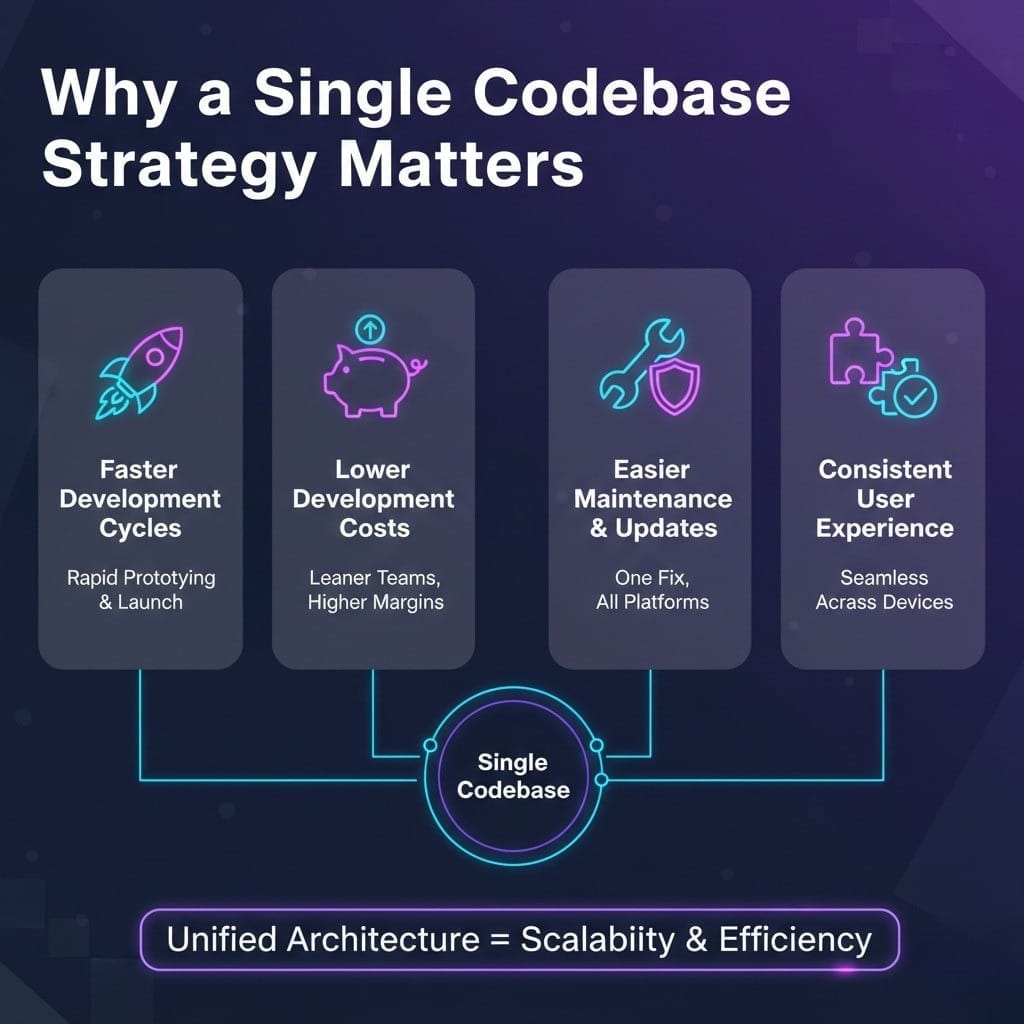
Faster Development Cycles
When teams write core logic once and deploy it across web, mobile, and desktop environments, development accelerates dramatically. Minimum Viable Products (MVPs) can launch simultaneously across platforms rather than sequentially. This not only shortens time-to-market but also strengthens competitive positioning. In fast-moving industries, speed often determines success.
Lower Development Costs
Maintaining multiple specialised teams for separate platforms increases operational overhead. A unified code base allows leaner teams to manage broader project scopes without compromising quality. Instead of allocating resources to repetitive development work, teams can focus on innovation, performance optimisation, and user experience improvements. Over time, this translates into stronger margins and more sustainable growth.
Easier Maintenance and Updates
Centralised logic means that when a bug appears, fixing it once resolves it across all connected platforms. Feature enhancements can be implemented once rather than rewritten multiple times. This dramatically reduces technical debt and simplifies long-term product evolution.
Consistent User Experience
A shared architecture ensures consistent workflows, authentication systems, and data handling processes across platforms. Users enjoy a seamless experience regardless of the device they are using. This consistency strengthens brand trust and improves satisfaction, reducing support issues and enhancing adoption.
Technologies That Enable One Codebase Development
Developing multi-platform applications from a single codebase has become increasingly practical thanks to modern frameworks and tools. Frontend frameworks like Vue and React allow developers to build responsive, interactive interfaces that adapt to multiple devices. On the backend, frameworks such as Laravel, ASP.NET Core, and Node.js provide the structure necessary for scalable, secure, and high-performance applications.
For mobile development, cross-platform frameworks like Quasar and React Native make it possible to deploy applications to both iOS and Android using shared code. Desktop applications can also benefit from wrappers like Electron, which package web applications as native software for Windows, macOS, and Linux. At the core of these technologies, an API-first architecture centralises communication between platforms, ensuring consistency and efficiency in data handling.
Low-Code IDEs further enhance this ecosystem by automating repetitive backend tasks, including CRUD operations, authentication, and role-based permissions. Platforms like RadSystems Studio empower developers to generate structured backend systems rapidly while maintaining complete control over the source code. This combination of modern frameworks and low-code automation enables agencies to accelerate delivery without sacrificing flexibility or quality.
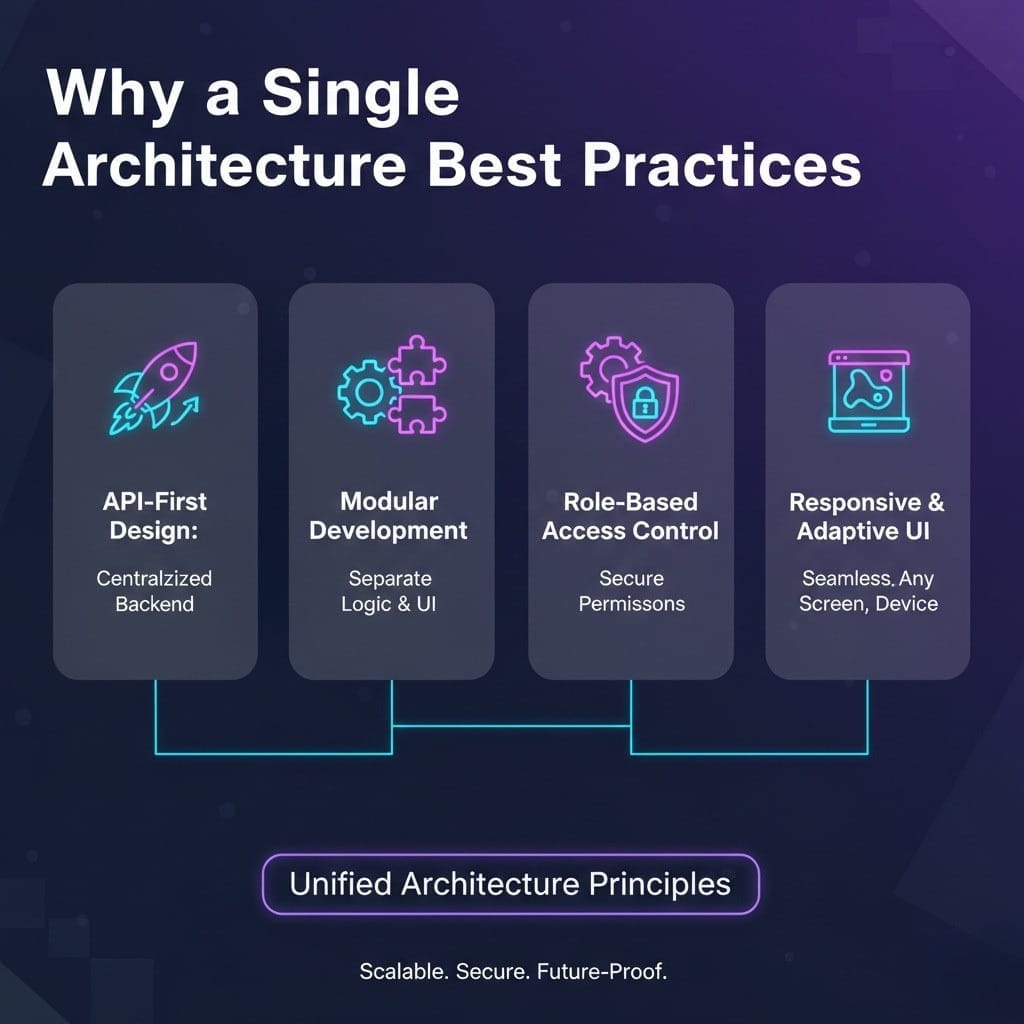
Architecture Best Practices
Implementing a single codebase successfully requires strategic architectural decisions. An API-first design ensures that all platforms communicate through a centralised backend, reducing redundancy and simplifying maintenance. Modular development, which separates business logic from presentation layers, preserves flexibility and allows developers to update or expand features without affecting the entire system.
A robust role-based access control system is essential to maintain security and operational efficiency. By defining structured permission levels early, teams can prevent unauthorised access and scale user management as the organisation grows. Finally, responsive and adaptive UI design ensures that applications remain intuitive and functional across devices, delivering a consistent experience to all users.
When Should You Use a Single Codebase?
A single codebase approach is ideal for a variety of business scenarios. It is particularly effective for launching Minimum Viable Products (MVPs) quickly, developing SaaS platforms, building client dashboards and portals, scaling internal enterprise tools, and serving both consumer and business users. While native development may still be necessary for applications requiring intensive hardware performance or platform-specific functionality, most business and enterprise applications see significant benefits from a unified development approach.
Strategic Advantage for Agencies
For agencies, adopting a one-codebase strategy offers a transformative competitive advantage. Instead of delivering a single website or app, agencies can provide comprehensive multi-platform solutions that include web platforms, mobile applications, desktop software, and administrative dashboards, all powered by a single, centralized codebase.
This approach reduces development time, lowers operational costs, and increases project value. Agencies can take on larger contracts, deliver faster results, and maintain healthier profit margins. By leveraging a unified codebase, teams can focus on enhancing features, optimizing user experiences, and driving innovation rather than duplicating effort across platforms.
Future-Proofing Your Applications
Technology evolves rapidly, and new platforms will emerge. Applications built on a unified, scalable architecture are easier to adapt. Adding new interfaces or features requires minimal changes to the core codebase, ensuring long-term sustainability and competitive advantage.
Build Once. Deploy Everywhere.
Building multi-platform apps from one codebase is not just a convenience; it is a strategic imperative. It enables faster delivery, lower costs, simpler maintenance, and a consistent user experience. By combining modern frameworks with scalable Low-Code IDEs like RadSystems Studio, teams can accelerate development while maintaining full control over their applications.
The future is multi-platform. Build once, deploy everywhere, and scale confidently.
Ready to accelerate your app development and deliver multi-platform solutions with ease? Explore how RadSystems Studio empowers agencies and teams to build robust, scalable, and high-performing applications from a single codebase.